
در فریلنسرها
فریلنسرها
استخدام حرفهای ترین فریلنسرها
پروژهها
کسب درآمد از طریق انجام پروژه
خدمات
جستجو میان خدمات تخصصی
نمونه کارها
بیش از ۱۰۰ هزار نمونه کار
برونسپاری
آموزش آنلاین
کسب درآمد



نمونه کار Rethinking Nitric Acid–Based Hydrometallurgy: Solvation–Oxidation Re engineering and the Design of Green, Thermodynamically Optimized, and Economically Sustainable Pathways for Yellowcake Production
خانه نمونه کارها Rethinking Nitric Acid–Based Hydrometallurgy: Solvation–Oxidation Re engineering and the Design of Green, Thermodynamically Optimized, and Economically Sustainable Pathways for Yellowcake Production

Rethinking Nitric Acid–Based Hydrometallurgy: Solvation–Oxidation Re engineering and the Design of Green, Thermodynamically Optimized, and Economically Sustainable Pathways for Yellowcake Production
ثبت پروژه مشابه دعوت به همکاری
۸ ۰
Abstract
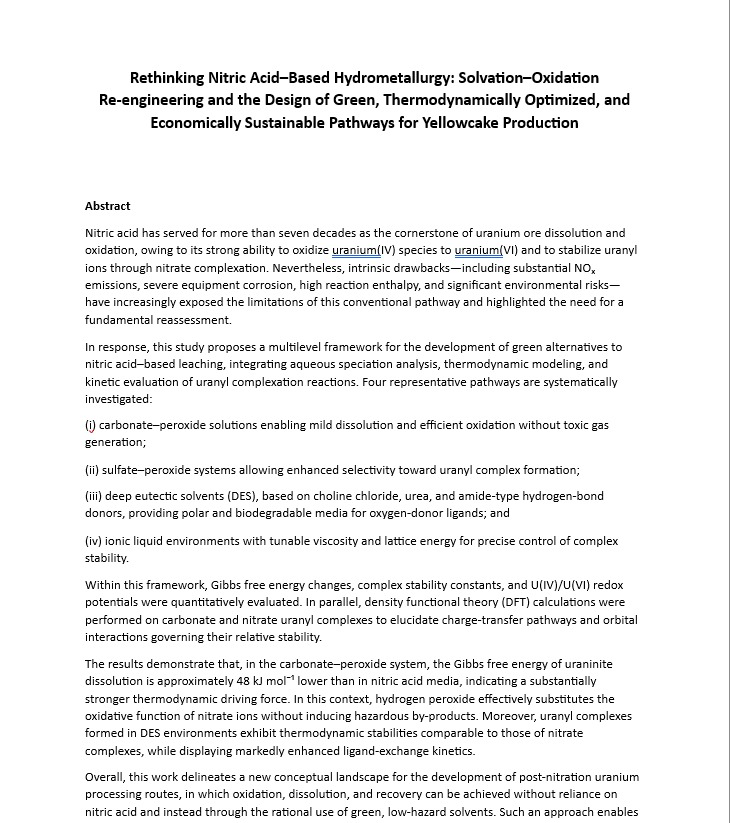
Nitric acid has served for more than seven decades as the cornerstone of uranium ore dissolution and oxidation, owing to its strong ability to oxidize uranium(IV) species to uranium(VI) and to stabilize uranyl ions through nitrate complexation. Nevertheless, intrinsic drawbacks—including substantial NOₓ emissions, severe equipment corrosion, high reaction enthalpy, and significant environmental risks—have increasingly exposed the limitations of this conventional pathway and highlighted the need for a fundamental reassessment.
In response, this study proposes a multilevel framework for the development of green alternatives to nitric acid–based leaching, integrating aqueous speciation analysis, thermodynamic modeling, and kinetic evaluation of uranyl complexation reactions. Four representative pathways are systematically investigated:
(i) carbonate–peroxide solutions enabling mild dissolution and efficient oxidation without toxic gas generation;
(ii) sulfate–peroxide systems allowing enhanced selectivity toward uranyl complex formation;
(iii) deep eutectic solvents (DES), based on choline chloride, urea, and amide-type hydrogen-bond donors, providing polar and biodegradable media for oxygen-donor ligands; and
(iv) ionic liquid environments with tunable viscosity and lattice energy for precise control of complex stability.
Within this framework, Gibbs free energy changes, complex stability constants, and U(IV)/U(VI) redox potentials were quantitatively evaluated. In parallel, density functional theory (DFT) calculations were performed on carbonate and nitrate uranyl complexes to elucidate charge-transfer pathways and orbital interactions governing their relative stability.
The results demonstrate that, in the carbonate–peroxide system, the Gibbs free energy of uraninite dissolution is approximately 48 kJ mol⁻¹ lower than in nitric acid media, indicating a substantially stronger thermodynamic driving force. In this context, hydrogen peroxide effectively substitutes the oxidative function of nitrate ions without inducing hazardous by products. Moreover, uranyl complexes formed in DES environments exhibit thermodynamic stabilities comparable to those of nitrate complexes, while displaying markedly enhanced ligand-exchange kinetics.
Overall, this work delineates a new conceptual landscape for the development of post nitration uranium processing routes, in which oxidation, dissolution, and recovery can be achieved without reliance on nitric acid and instead through the rational use of green, low hazard solvents. Such an approach enables the redesign of a critical segment of the nuclear fuel cycle toward improved sustainability, intrinsic safety, and environmental compatibility.
نمونهکار را به اشتراک بگذارید
کپی لینک


گزارش تخلف
نمونه کارهای مشابه

برترین مهارت ها
کارلنسر
کارلنسر (Karlancer)، پلتفرم فریلنسینگ و دورکاری اینترنتی، جهت استخدام فریلنسرهای حرفهای در ایران است. از جمله پروژههایی که میتوانید آنها را برون سپاری کنید و یا انجام دهید، میتوان به: برنامه نویسی، ساخت اپلیکیشن و نرم افزار، طراحی سایت، تولید محتوای سایت و شبکههای اجتماعی، تایپ و ترجمه، عکاسی، طراحی (لوگو، بنر، پوستر، چهره و...)، ویراستاری، بازاریابی، دیجیتال مارکتینگ، سئو SEO (بهینهسازی موتورهای جست و جو)، ادیت و ویرایش عکس، ساخت و تدوین کلیپ و تیزر، ساخت اینفوگرافیک، مدلسازی، ویرایش فایلهای صوتی، آهنگسازی، پروژههای مهندسی، علوم تجربی، هنر، معماری، طراحی داخلی و... اشاره کرد. با کارلنسر، همراه شما هستیم.
کارلنسر در یک نگاه
کارلنسر را در شبکه های اجتماعی دنبال کنید
شماره تماس
آدرس ایمیل
تمامی حقوق مادی و معنوی این وب سایت به شرکت کارلنسر تعلق دارد